Conway's Law and Team Topologies: Aligning Architecture with Organization
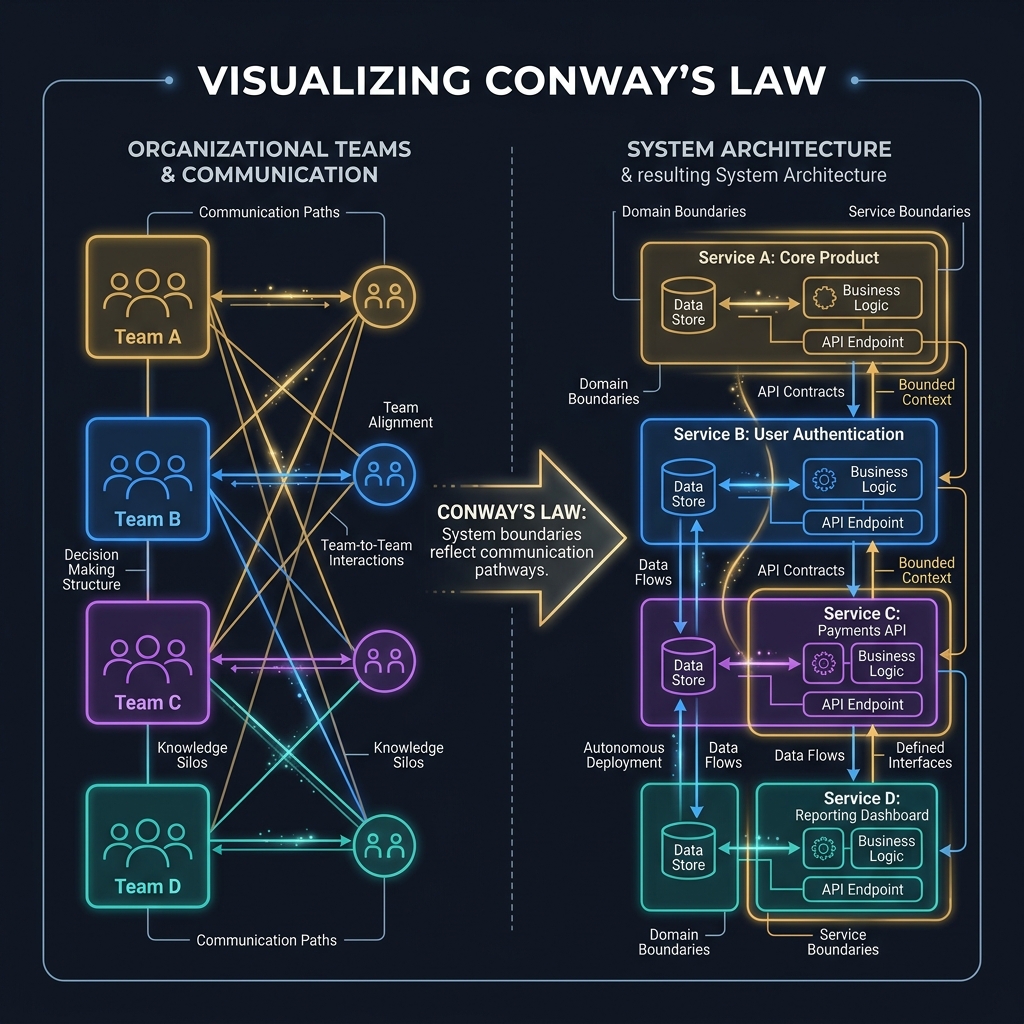
Your system architecture is secretly a mirror of your org chart — Conway's Law is not a metaphor, it's a structural force. This post breaks down how to wield the Inverse Conway Maneuver and Team Topologies interaction modes to design both your teams and your software intentionally.
Concept
In 1967, Melvin Conway submitted a paper that was rejected by the Harvard Business Review for "lack of evidence." It was eventually published in Datamation under the now-famous observation: "Any organization that designs a system will produce a design whose structure is a copy of the organization's communication structure."
This wasn't a warning. It was a physical constant.
What Conway articulated is not a management philosophy — it's a structural force rooted in information theory. Teams communicate through interfaces. Software modules communicate through APIs. The boundaries of communication define the boundaries of coupling. You cannot decouple modules faster than you can decouple the teams that own them. The reverse is also true: you cannot decouple teams if the modules they own remain tightly coupled.
Senior engineers often encounter this late in the game — when a "microservices migration" produces a distributed monolith because the team structure was never restructured alongside the architecture. The services look independent on the diagram but remain tightly coupled through a shared database, a shared release cycle, or constant cross-team coordination for every deployment.
The Team Topologies framework (Skelton & Pais, 2019) operationalizes Conway's Law into prescriptive team structures. It defines four team types and three interaction modes that, when aligned with system boundaries, create sustainable sociotechnical architecture.
The Four Team Types
Stream-aligned teams own a slice of the user-facing value stream end to end — a product feature, a customer journey, a domain capability. They minimize dependencies and maintain autonomous delivery.
Platform teams build internal products consumed by stream-aligned teams. The cognitive load reduction they provide is the primary metric — not feature throughput. A good platform team makes the "paved road" so compelling that stream-aligned teams choose it over building their own.
Enabling teams are temporary catalysts. They embed with stream-aligned teams to transfer capability — a security guild helping a team adopt zero-trust patterns, for example — then disengage. They do not own infrastructure or build products.
Complicated-subsystem teams own components with high intrinsic complexity (ML inference engines, media codecs, cryptographic primitives) that require deep specialists. They expose well-defined interfaces and absorb cognitive load that stream-aligned teams cannot economically carry.
The Three Interaction Modes
Collaboration is high-bandwidth, high-cognitive-load, time-bounded. Two teams work together intensely to discover new boundaries. This is appropriate during domain exploration, not steady-state operations.
X-as-a-Service is low-bandwidth, low-cognitive-load, indefinite. One team consumes another's output through a stable API contract. This is the steady-state goal.
Facilitating is enabling-team mode — one team helps another improve capability without creating dependency.
The architectural insight: the interaction mode between teams predicts the coupling mode between their services. Teams in collaboration mode will produce APIs that leak implementation details. Teams in X-as-a-Service mode will produce stable, versioned contracts.
Constraints
The core constraint of Conway's Law is communication bandwidth. Teams can only coordinate across boundaries at a limited rate. When the system design requires more cross-boundary communication than the org structure can sustain, you accumulate coordination debt — which manifests as delayed releases, integration bugs, and tribal knowledge.
A second constraint is cognitive load capacity. Research in team psychology consistently puts the upper bound of a well-functioning team at 5–9 engineers. When a team owns too large a surface area, architectural quality degrades not from malice but from the impossibility of holding the full context.
A third constraint is Conway's Law operating at multiple scopes simultaneously. The law applies within a team (sub-team communication shapes module structure), between teams (service coupling), between departments (platform-product coupling), and between organizations (API design between companies). Architects who fix it at one scope often inadvertently break it at another.
The Org Topology Anti-Pattern: The Ops Silo
Consider the traditional organization with a Dev team and an Ops team separated by a formal handoff process. Conway's Law predicts — and observes — that this produces software with a hard boundary between "the thing that runs" and "the thing that deploys it." That boundary becomes the source of deployment friction, incident war rooms, and "throw it over the wall" culture. DevOps is not primarily a tooling philosophy; it's a Conway's Law correction.
Trade-offs
The Inverse Conway Maneuver
The Inverse Conway Maneuver (ThoughtWorks Technology Radar, 2015) argues: don't let your org structure accidentally define your architecture. Deliberately design your org structure to produce the architecture you want.
This is the only leverage point architects actually have. You cannot force technical decoupling faster than organizational decoupling. But you can restructure teams first, then allow the architecture to follow.
The trade-off is timing and pain. Restructuring teams is organizationally expensive — it breaks working relationships, disrupts momentum, and creates a period of reduced velocity. The payoff is architectural cleanliness that compound-interests over years. Organizations that restructure teams without restructuring architecture, or vice versa, pay the cost twice.
Stream-Aligned vs. Shared Services
The temptation is to extract "shared" functionality into a shared services team. This looks efficient on a cost model — one team owns authentication, consumed by twelve product teams — but it creates a coupling hub that becomes a release bottleneck.
The correct trade-off analysis:
| Approach | Latency to Change | Coupling Risk | Team Autonomy |
|---|---|---|---|
| Shared service team | High (cross-team scheduling) | High (shared deployment) | Low |
| Platform team (X-as-a-Service) | Low (stable API contract) | Low (versioned) | High |
| Duplicated capability | None (autonomous) | None | Maximum |
Duplication is underrated. For non-critical shared logic, the cost of a second copy is almost always lower than the coordination cost of the shared service model.
Cognitive Load Budgeting
Every team has a finite cognitive load budget. The budget is spent on: domain complexity, technical complexity, and environmental complexity (CI/CD, cloud configuration, on-call). Platform teams exist to reduce environmental complexity, freeing budget for domain complexity. When platform teams fail to reduce cognitive load — because their APIs are poorly documented, their SLAs unreliable, or their upgrade paths breaking — they consume budget instead of returning it, and stream-aligned teams route around them.
Code
The following demonstrates a TeamBoundaryEnforcer — a compile-time attribute pattern that codifies team ownership and enforces the architectural principle that cross-boundary calls must go through declared contracts, not direct assembly references.
// TeamOwnershipAttribute.cs
// Applied to assemblies or namespaces to declare ownership
[AttributeUsage(AttributeTargets.Assembly | AttributeTargets.Class)]
public sealed class TeamOwnershipAttribute : Attribute
{
    public string TeamName { get; }
    public TeamType Type { get; }
    public InteractionMode AllowedInteractionMode { get; }

    public TeamOwnershipAttribute(
        string teamName,
        TeamType type,
        InteractionMode allowedInteractionMode)
    {
        TeamName = teamName;
        Type = type;
        AllowedInteractionMode = allowedInteractionMode;
    }
}

public enum TeamType
{
    StreamAligned,
    Platform,
    ComplicatedSubsystem,
    Enabling
}

public enum InteractionMode
{
    XAsAService,    // Stable versioned API only
    Collaboration,  // Active joint development — time-bounded
    Facilitating    // Enabling team mode — temporary
}

// Usage: applied to the platform team's assembly
[assembly: TeamOwnership("payments-platform", TeamType.Platform, InteractionMode.XAsAService)]

// PaymentGatewayContract.cs — the explicit API surface
// Stream-aligned teams depend ONLY on this contract, never on internals
public interface IPaymentGatewayContract
{
    Task<PaymentResult> AuthorizeAsync(
        AuthorizationRequest request,
        CancellationToken cancellationToken = default);

    Task<RefundResult> RefundAsync(
        RefundRequest request,
        CancellationToken cancellationToken = default);
}

// Any stream-aligned team consuming the payment platform:
[TeamOwnership("checkout-stream", TeamType.StreamAligned, InteractionMode.XAsAService)]
public class CheckoutService
{
    private readonly IPaymentGatewayContract _paymentGateway;

    public CheckoutService(IPaymentGatewayContract paymentGateway)
    {
        // Dependency on contract only — never on PaymentGatewayImpl
        _paymentGateway = paymentGateway;
    }

    public async Task<CheckoutResult> ProcessAsync(CartCheckoutRequest request)
    {
        var authRequest = new AuthorizationRequest
        {
            Amount = request.TotalAmount,
            Currency = request.Currency,
            CustomerId = request.CustomerId,
            IdempotencyKey = request.OrderId.ToString()
        };

        var result = await _paymentGateway.AuthorizeAsync(authRequest);
        return result.IsSuccess
            ? CheckoutResult.Successful(result.TransactionId)
            : CheckoutResult.Failed(result.FailureReason);
    }
}
The second example models the cognitive load budget calculation as a first-class concept that architects and engineering managers can use to decide when to split a team or extract a platform capability:
// CognitiveLoadBudget.cs
// Models the cognitive load a team carries — used in org design reviews
public record CognitiveLoadBudget
{
    // Intrinsic load: complexity inherent to the domain
    public int DomainComplexityScore { get; init; }

    // Extraneous load: CI/CD, cloud config, on-call, tooling
    public int EnvironmentalComplexityScore { get; init; }

    // Germane load: learning and skill-building
    public int LearningInvestmentScore { get; init; }

    public int TotalLoad => DomainComplexityScore
                          + EnvironmentalComplexityScore
                          + LearningInvestmentScore;

    // A team of 6 engineers has roughly 60 units of cognitive load capacity
    // (rough heuristic from Team Topologies practice)
    public const int MaxTeamCapacity = 60;

    public bool IsOverloaded => TotalLoad > MaxTeamCapacity;

    public string DiagnoseBottleneck()
    {
        if (EnvironmentalComplexityScore > 25)
            return "Platform gap — environmental load exceeds 25 units. Consider platform team extraction.";
        if (DomainComplexityScore > 30)
            return "Domain too wide — split team by bounded context.";
        if (LearningInvestmentScore > 15)
            return "High learning curve — engage enabling team temporarily.";
        return "Load within bounds.";
    }
}

// Architect's org design review helper
public class OrgDesignReview
{
    public IReadOnlyList<TeamDiagnostic> AnalyzePortfolio(
        IEnumerable<TeamSnapshot> teams)
    {
        return teams
            .Select(team => new TeamDiagnostic
            {
                TeamName = team.Name,
                Budget = team.ComputeCognitiveLoadBudget(),
                Recommendation = team.ComputeCognitiveLoadBudget().DiagnoseBottleneck(),
                SplitCandidate = team.ComputeCognitiveLoadBudget().IsOverloaded
            })
            .OrderByDescending(d => d.Budget.TotalLoad)
            .ToList();
    }
}
Further Reading
- Module 3 – Distributed Systems Fundamentals — foundational service boundary theory
- Module 9 – API Design & Contracts — designing stable X-as-a-Service contracts
- Module 16 – Governance & Architecture Decision Making — formalizing team topology decisions
- Module 14 – Platform Engineering — building internal developer platforms that reduce cognitive load
External references:
- Skelton, M. & Pais, M. (2019). Team Topologies. IT Revolution Press.
- Conway, M.E. (1968). "How Do Committees Invent?" Datamation, 14(4), 28–31.
- ThoughtWorks Technology Radar (2015). "Inverse Conway Maneuver."